Building the Conditions for Arts & Culture
Jersey City has no shortage of culture. Artists, galleries, libraries, organizers, neighborhood leaders, businesses, and residents are already shaping it every day.
The harder question is how the institutions around that culture can listen well, make better decisions, build trust, and turn participation into lasting capacity.
Through ongoing work with the Jersey City Arts Council (JCAC), I've been applying a systems-design practice to that challenge—moving between community engagement, synthesis, governance, organizational design, communications, relationship-building, and resource development.
The work is less about designing a single outcome than strengthening the conditions that allow an institution—and the ecosystem around it—to act.
Start with the people already shaping the system.
One of the earliest expressions of this work came through Reimagining the Future of JCAST, a community forum organized by JCAC to gather and synthesize public input for the Jersey City Office of Cultural Affairs as it considered JCAST's next chapter.
The goal wasn't to redesign JCAST ourselves. It was to create a process through which artists, residents, cultural organizers, and other stakeholders could articulate what the citywide arts experience needed to become.
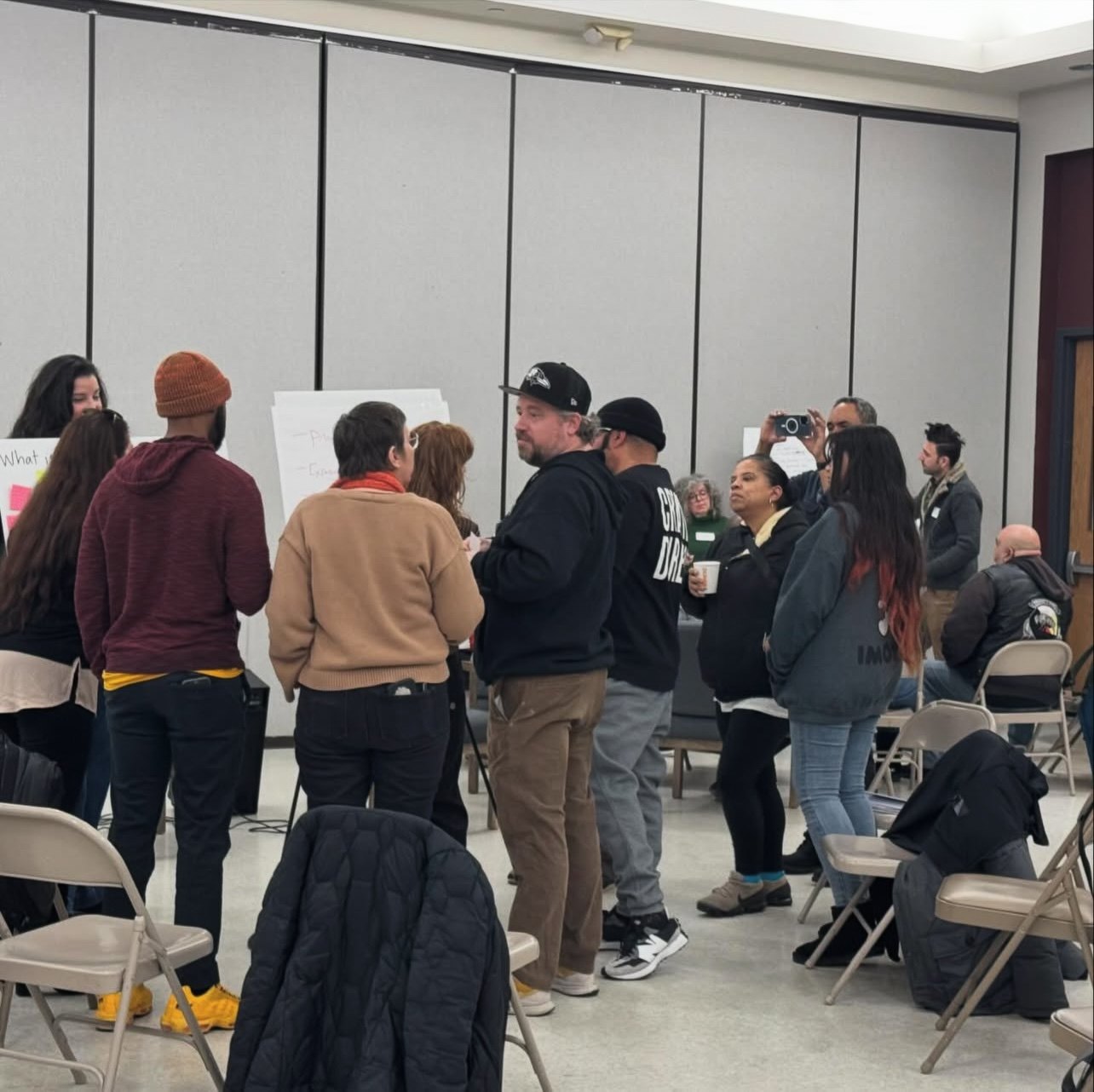
Approximately 50 participants worked across five groups. I helped design the exercises and meeting structure, facilitated conversations, documented observations, asked follow-up questions, and supported participants as they developed and presented their ideas.
Questions of access, artist opportunity, neighborhood participation, representation, promotion, logistics, cultural impact, and experimentation surfaced throughout the room.
- ~50
- Participants
- 5
- Working groups
- 1
- Shared question—what should JCAST become?
FIG. 03a / Contact sheet—Reimagining the Future of JCAST
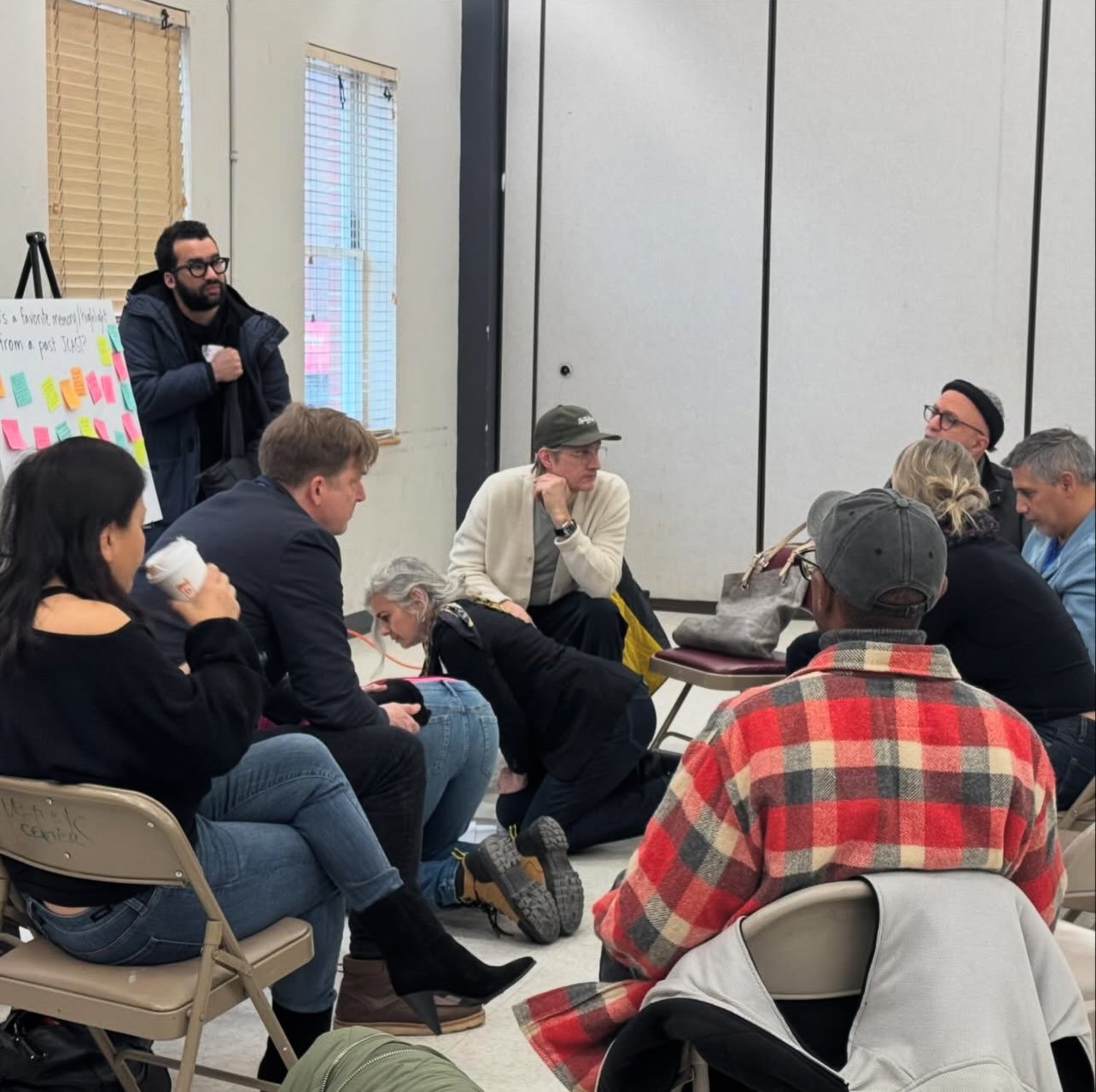
The room, mid-discussion
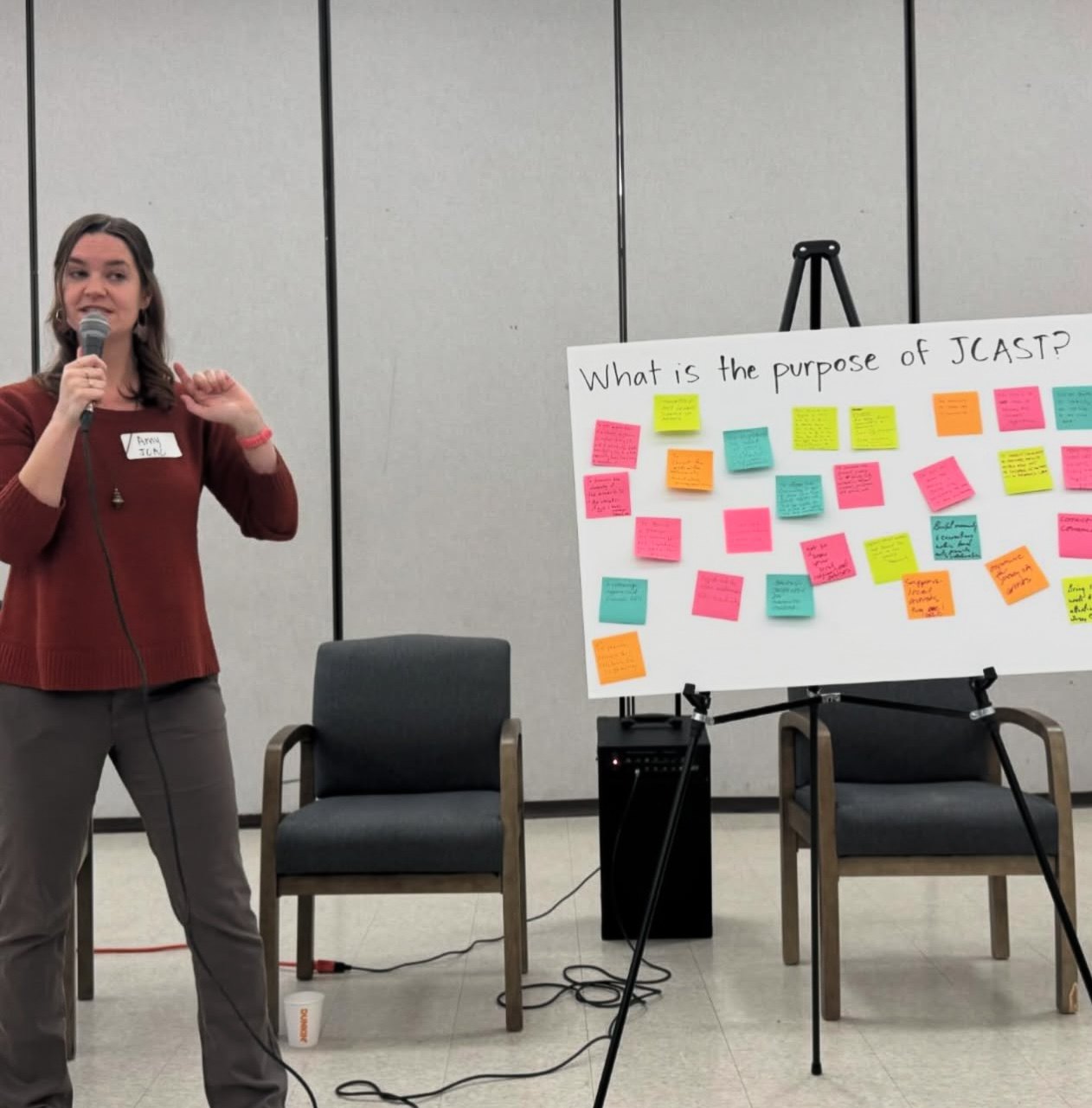
Facilitating a working group
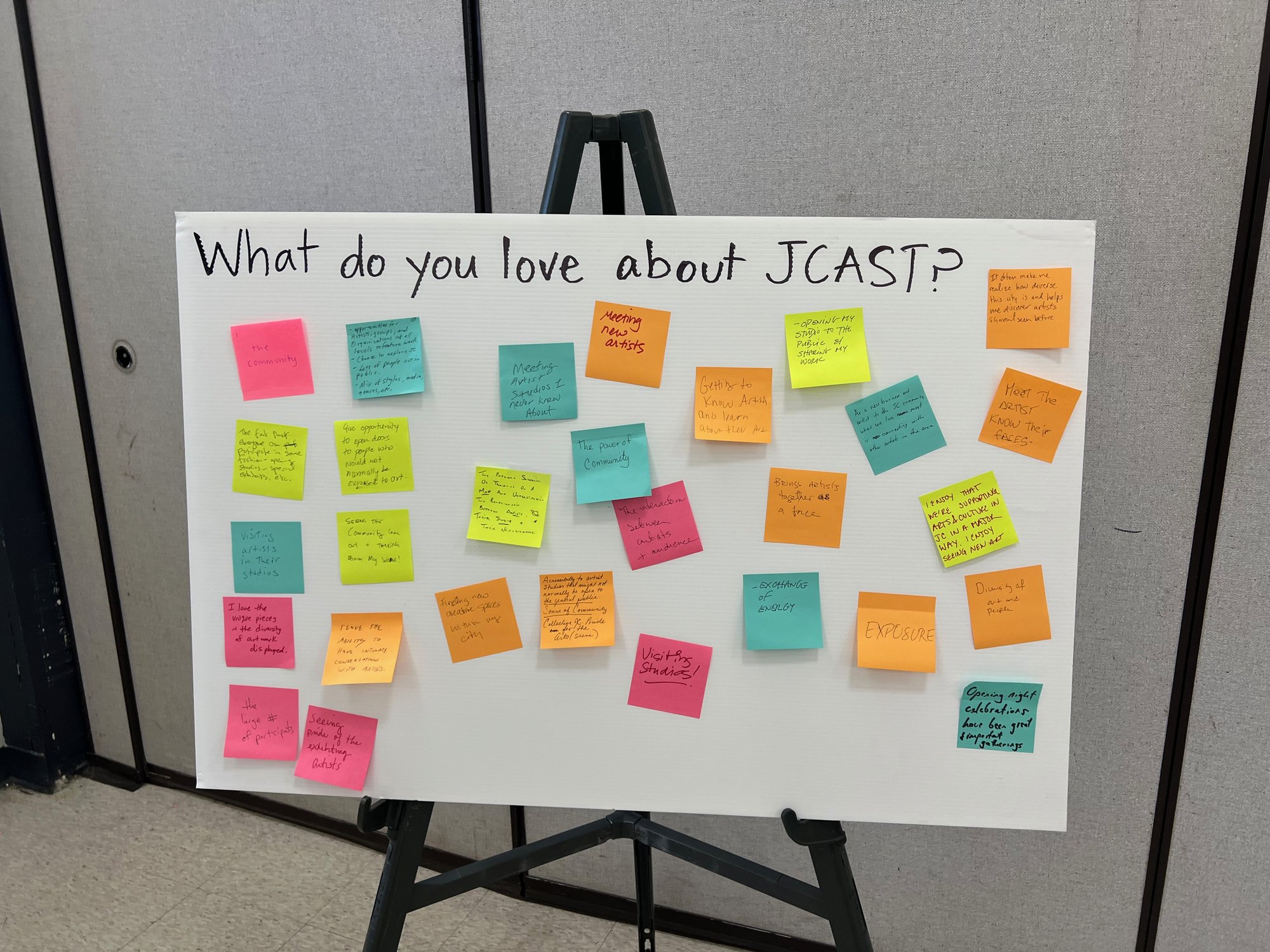
Prompt: What do you love about JCAST?
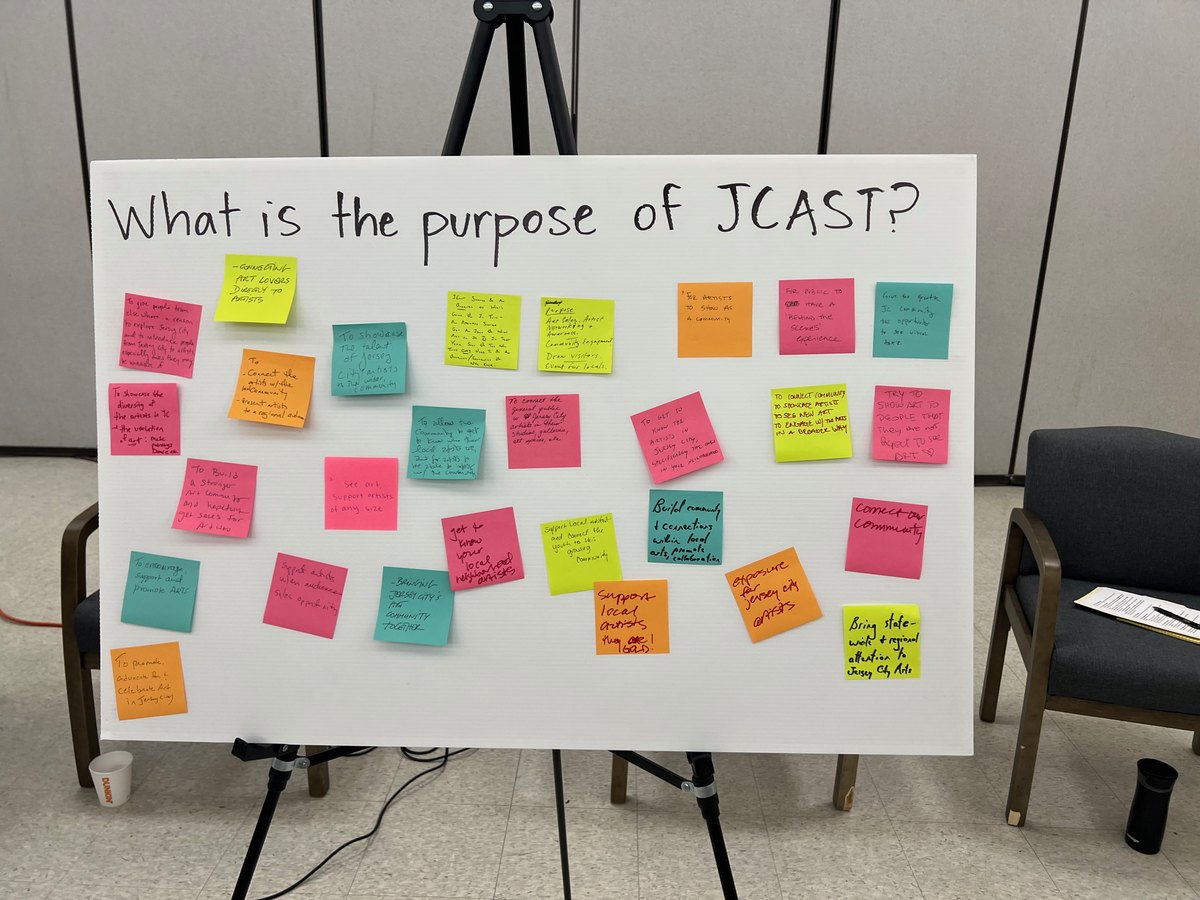
Prompt: What is the purpose of JCAST?
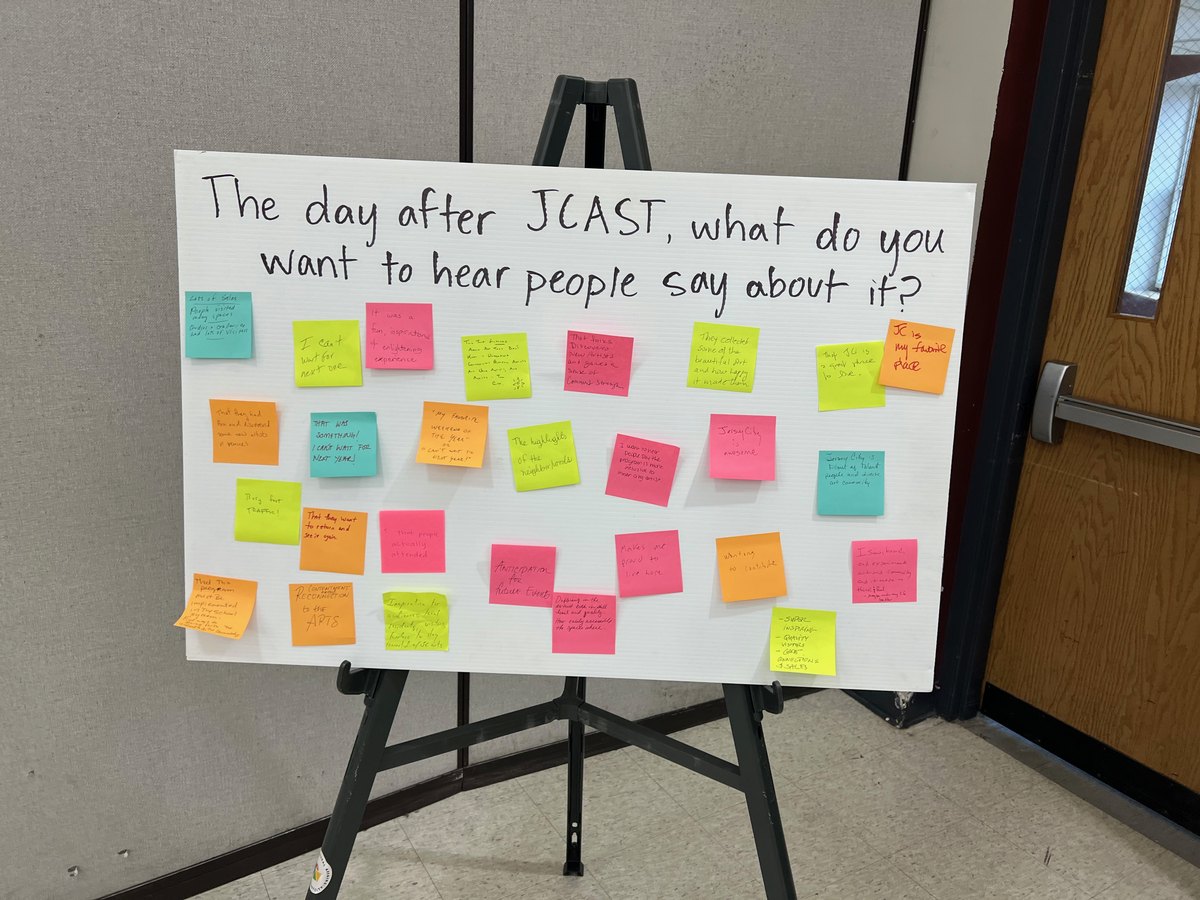
Prompt: The day after JCAST
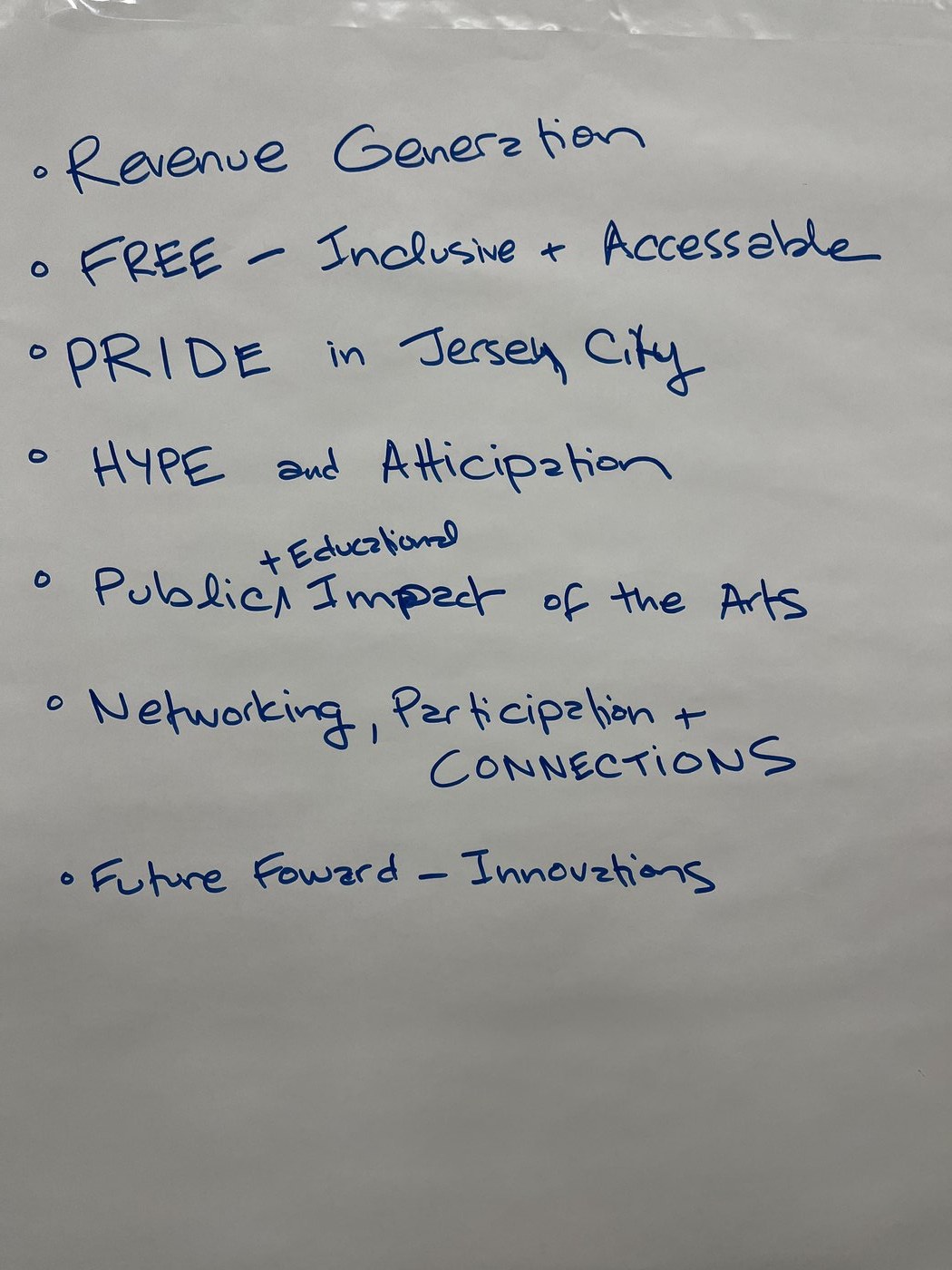
A group's themes, as written
Between sessions
Original forum photography, shown at the scale each frame can hold—no upscaling, no retouching.
Turn many voices into shared intelligence.
After the forum, I took responsibility for synthesizing the complete body of participant notes, poster boards, and group presentations.
I compared recurring ideas across the five groups, reconciled overlaps and tensions, and organized the material into eight themes spanning access, community connection, artist opportunity, promotion, diverse expression, logistics, cultural impact, and innovation.
FIG. 03c / Distributed input, five working groups, eight shared themes
I then wrote and designed the Community Feedback Report, translating the research into an accessible narrative that could travel beyond the room where it happened.
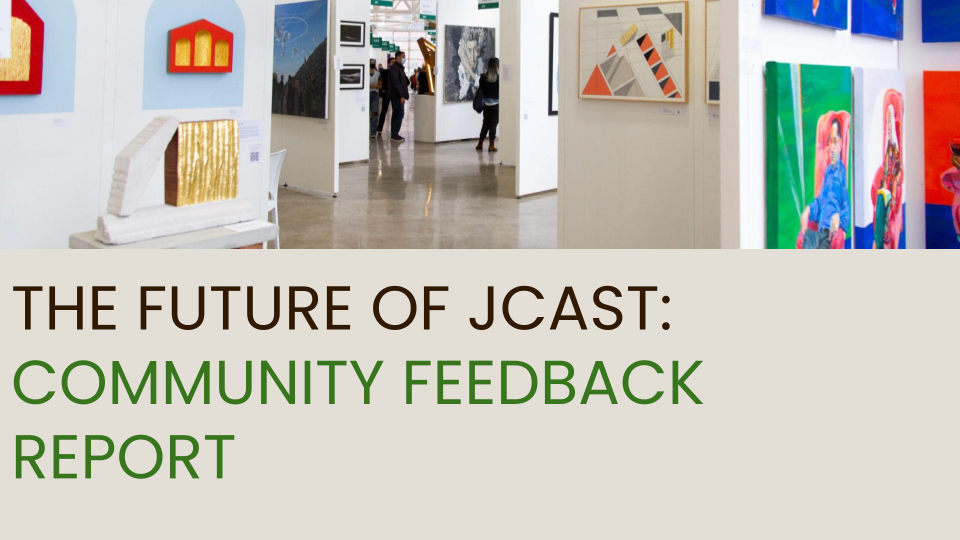
FIG. 03d / The published Community Feedback Report
The report had to survive the room it came from—readable by people who were never in it, and specific enough for an office deciding what to do next.
One statement the eight themes had to hold together.
The community envisions JCAST as a vibrant, inclusive celebration that unites people, empowers artists, and strengthens Jersey City's cultural and economic landscape.
They want an experience that is accessible to all, fosters deep connections, and continually innovates to reflect the city's dynamic and diverse creative spirit.
The eight themes as published—access, community connection, artist opportunity, promotion, diverse expression, logistics, cultural impact, and innovation.
- 01
Inclusive Access
Ensure JCAST remains free, welcoming, and accessible to all, removing barriers and fostering a sense of belonging.
- 02
Community Connections
Strengthen connections between artists, neighborhoods, and attendees to create a deeper sense of unity and cultural pride.
- 03
Artist Opportunities
Expand revenue opportunities through sales, sponsorships, and partnerships that support artists year-round.
- 04
Strategic Promotion
Enhance outreach through social media, email and partnerships to build excitement and increase visibility.
- 05
Diverse Expression
Broaden the scope of art forms showcased, highlighting Jersey City's rich and diverse creative talents.
- 06
Event Logistics
Improve transportation, venue accessibility, and scheduling to optimize the JCAST experience for all participants.
- 07
Cultural Impact
Engage schools and families to foster creativity and make JCAST an educational opportunity for the entire community.
- 08
Future Innovation
Evolve JCAST with new ideas and technologies to keep it fresh, relevant, and future-focused.
After review with JCAC leadership, the report was delivered to the Office of Cultural Affairs as a decision-support artifact. The City subsequently selected Creative Side to operate JCAST; implementation belonged to Cultural Affairs and its selected partner.
That boundary matters.
The community generated the intelligence. Design gave it structure. The institution decided how to act on it.
Turn institutional intent into something people can operate.
Over the year that followed, my work expanded from community engagement into the systems behind JCAC itself.
As the organization prepared for its next chapter, I became increasingly involved in questions of governance, mission and core values, Board structure, and long-term organizational capacity.
As Board Secretary and a member of the Executive Committee, I led much of the work translating that evolution into a clearer governance model. Working at the direction of Board leadership and in consultation with outside counsel, I drove a governance reset culminating in the adoption of newly amended and restated bylaws in May 2026.
The work extended beyond the bylaws into the mechanisms that make governance usable in practice: board expectations and policies, onboarding, decision-making processes, leadership structure, and succession planning.
Inside the system being redesigned, not adjacent to it.
Each component answers an institutional question and needs a mechanism behind it. Select a component to read its pair.
Under what rules does the organization operate?
A governance reset, culminating in amended and restated bylaws adopted in May 2026.
- Purpose
- Roles
- Authority
- Decisions
- Accountability
- Expectations
- Onboarding
- Processes
- Leadership
- Succession
FIG. 03g / Components of institutional work, and what they have to produce to be usable
At the same time, I synthesized Board and Advisory Committee discussions around organizational purpose, priorities, and unresolved tensions into working alignment documentation that helped move leadership toward shared direction. That process contributed to JCAC's new mission, pillars, and values and the strategic-planning work now underway.
The challenge isn't simply to write better rules. It's to create enough clarity around purpose, roles, authority, decisions, and accountability for people to operate together.
That has become particularly important as JCAC navigates leadership transitions and a longer-term evolution from a working board toward a governing board—requiring clearer boundaries between governance, leadership, and execution.
A formal structure can create clarity. Making that structure work requires capacity.
The system is only as strong as the people inside it.
When JCAC expanded its Board, more than 20 nominations and applications created an opportunity to rethink recruitment around organizational needs.
Instead of asking only Who is impressive?, we started with a more useful question.
What does the institution need?
Not a list of impressive people. A list of capabilities the organization is missing.
- 01
Fundraising reach
- 02
Legal and nonprofit expertise
- 03
Community relationships
- 04
Geographic representation
- 05
Leadership capacity
- 06
Interest and availability
FIG. 03h / Organizational needs, stated first
I helped redesign and lead a recruitment process that moved from candidate prioritization through interviews, structured evaluation, recommendations, nomination, election, and onboarding. The process resulted in the election of two new directors while establishing a more deliberate approach to future Board composition.
- 01Prioritization
- 02Interviews
- 03Structured evaluation
- 04Recommendation
- 05Nomination
- 06Election
- 07Onboarding
Composition, not headcount. What changes is the institution's capability to act—reach, expertise, relationships, geography, leadership, and available time.
FIG. 03i / Needs, evaluation, composition, capability
Recruitment isn't simply about filling seats. It's about building the right mix of capabilities—understanding what different people bring, where institutional gaps exist, and how individual strengths connect to organizational needs.
The work has also exposed the limits of formal systems.
A Board agreement can establish expectations. A fundraising commitment can define responsibility. An onboarding guide can explain how the organization works.
None of those can manufacture ownership.
Morale matters. Motivation matters. Relationships matter. Available capacity matters.
The operating system is human.
Institutions operate through relationships as much as rules.
The more time I've spent inside JCAC, the clearer it has become that Jersey City's cultural ecosystem is not experienced evenly.
Investment, visibility, cultural resources, and access vary across neighborhoods. Questions of representation sit alongside questions of gatekeeping, compensation, development, institutional trust, and who gets to participate in defining the city's cultural identity.
My first year on the Board was largely about understanding the institution. My second has become increasingly outward-facing.
Across McGinley Square and the Monticello Avenue corridor, Bergen-Lafayette, Journal Square, Downtown, and beyond, I've been spending more time with the artists, organizers, businesses, and residents already creating cultural life across Jersey City.
At the Jersey City Free Public Library's West Bergen Branch, conversations with Branch Manager Deborah "Miss Debbie" Oriol have helped me better understand how trusted neighborhood institutions can function as cultural infrastructure in their own right.
In the Heights, I'm helping plan an upcoming community forum with Councilman Jake Efros—another opportunity to listen before deciding what institutional response might be useful.
And through broader civic and development spaces, I've been building relationships with municipal leaders and people working across real estate, law, investment, and development—learning how cultural and community perspectives might enter conversations before decisions about neighborhoods are already made.
A common principle connects those efforts:
The work is already happening.
The role of an institution isn't always to create something new. Sometimes it's to recognize what's already there, connect people doing the work, and understand where it can add leverage rather than duplication.
Communications has become part of that connective tissue too. Across the Individual Artist Fellowship, Annual Meeting + Mixer, City Conversations, panels, roundtables, and other programming, I've developed a repeatable visual approach that helps JCAC communicate programs and opportunities more consistently and efficiently.
The goal isn't communication for its own sake. It's reducing the distance between the institution and the people it hopes to reach.
Visibility alone isn't trust.
Trust comes from showing up, communicating clearly, following through, and giving people evidence that participation matters.
The work is already happening.
McGinley Square · Monticello Avenue · Bergen-Lafayette · Journal Square · Downtown · The Heights
Neighborhood by neighborhood, the role is to recognize what is already there, connect the people doing it, and add leverage rather than duplication.
Build the capacity to keep going.
Institutional impact depends not only on good ideas and strong relationships, but on the resources to sustain them.
That opportunity is becoming tangible as JCAC approaches its 10-year anniversary in November 2026.
With planning underway for the anniversary fundraiser at Saint Peter's University, I'm leading marketing, visual and experiential design—shaping how the event comes to life across communications, environment, guest touchpoints, photography and videography, and production coordination.
The broader effort brings together storytelling, partnerships, fundraising, and community around a shared milestone—using the anniversary not only to celebrate JCAC's first decade, but to build momentum for what comes next.
At the center of that next chapter is the emerging Jersey City Arts Council Artist Emergency Fund, conceived by Executive Director Deonté Griffin-Quick and now being developed as a new mechanism for direct artist support.
The fund is still taking shape, but its ambition is concrete: build a resource that can respond when Jersey City artists face moments of urgent financial need.
It creates a direct connection between the infrastructure being strengthened behind the scenes and the public value that infrastructure can make possible.
10-year anniversary
November 2026 · Saint Peter's University
Planning underway—marketing, visual and experiential design, and production coordination.
Artist Emergency Fund
Conceived by Deonté Griffin-Quick, Executive Director
Being developed as a new mechanism for direct artist support.
Stronger governance
Deeper relationships
Greater visibility
New resources
Capacity in service of artists.
Civic infrastructure isn't a staircase. It's a loop.
The six modes are recurring modes of civic practice, not sequential project phases. Action happens throughout them.
Lived cultural experience can become shared intelligence. Shared intelligence can become institutional and collective capacity. Capacity can enable action—and action changes the conditions of the ecosystem.
Changed conditions produce new information, needs, relationships, and tensions. So the work returns to listening, carrying whatever the last pass accumulated: knowledge, trust, capability, institutional memory.
Sometimes it returns with nothing gained. A need can come back because information never reached people, capacity was insufficient, ownership was unclear, resources weren't available, authority sat elsewhere, or conditions changed. The loop describes movement, not guaranteed progress.
Six recurring modes, not six sequential phases—action happens throughout. Each band is one pass through them. You return to listening, but not to the same condition. Hover or focus a mode to read what it does.
- 01 / Listen
Make lived experience, needs, assets, and tensions visible.
- 02 / Synthesize
Turn distributed perspectives into shared intelligence.
- 03 / Structure
Give that intelligence somewhere to live—clearer roles, mechanisms, responsibility, and decision-making.
- 04 / Build capacity
Develop the people, knowledge, capabilities, and organizational ability required to act.
- 05 / Connect
Link people and institutions to relationships, authority, opportunity, resources, and one another.
- 06 / Sustain
Create enough resources, ownership, and continuity for value to persist and future action to remain possible.
The next pass starts with more than the last one did: knowledge, relationships, trust, capability, institutional memory. Sometimes it starts with the same need still unresolved.
The system is open. Information, funding, authority, policy, partnerships, and audiences all enter from outside it.
FIG. 03 / The Civic Infrastructure Loop—an open, accumulative system
What the work is teaching me
This work has challenged some of the assumptions I've developed designing inside professional teams and organizations.
Civic and nonprofit systems have required me to think differently about authority, incentives, accountability, and execution.
Nonprofit Board members are usually volunteers. Authority is distributed. People bring different levels of time and capacity. Institutional histories outlast leadership changes. And formal decisions still depend on relationships, ownership, and follow-through to become real.
A perfectly documented process can still fail if no one has the capacity or motivation to carry it.
That has sharpened how I think about design.
A policy can clarify responsibility. It cannot create commitment.
A forum can create participation. It cannot create trust without follow-through.
Communications can make an institution more legible. They cannot make it credible by themselves.
The harder infrastructure is human:
Trust. Motivation. Representation. Relationships. Shared ownership. Capacity.
For a cultural institution operating within a city shaped by uneven investment, changing neighborhoods, competing priorities, and longstanding questions of access and equity, strengthening that connective tissue is not separate from the work.
It is the work.
And perhaps that is the larger lesson.
The work of civic design isn't only creating better artifacts, programs, policies, or experiences. It is helping create the conditions in which people and institutions can use them well.
Civic infrastructure isn't something you finish designing. It's something you continuously steward.
From participation to infrastructure, the opportunity remains the same: make complexity legible enough for people to move through it together.